Friday, February 4, 2011

In-depth look: Ranger


The ranger is a nature-themed adventurer profession which combines their use of pets with mobile combat and a focus on ranged attacks. The ranger can use a wide variety of weapons, but they tend to favor bows. Their repertoire of utility skills focuses on pet buffs, traps and spirits of nature.


Ranger concept art.

The unique profession ability for the ranger is their three named, controllable pets. Most of the time a ranger only has access to one of their pets, but they can swap them outside of combat or through the use of utility skills. Rangers have been announced to have a utility skill which allows stealth.
A pet's level is based on its owner's level, which determines base attack, armor, and health. In addition to this, each pet has an evolution level, which advances if that pet is active while its owner gains experience. Pets start out with no pet skill slots but, as they gain evolution levels, up to four pet skill slots become available. A pet's equippable skills are based on its specific pet type.
Rangers have a special user interface element for controlling their pets that provides simple behavioral modes and direct commands for their pets, but they cannot directly command their pets' skill usage.

Special skill types
  • Chains — three skills that share a single skill slot, which are executed in sequence on a single target.
  • Preparations — apply a preparation to a weapon to change its abilities.
  • Spirit skills — summon a nature spirit that influences the area around it.
  • Traps — utility skills that can be placed at a ranger's current location. When an enemy enters a trap, it is triggered.

Traits
A ranger has two general trait lines to choose from: Wilderness Survival and Beast Mastery. They also have trait lines for each of the weapons they can wield.
See list of ranger traits.


Attributes
Rangers can put attribute points into Strength, Agility, Vitality, and Perception, the other attributes being considered minor for this profession.

Armor
The ranger is an adventurer profession and they will use medium armor.

Weapons
  • Two-handed
    • Greatsword — A brute force, heavy-damage weapon.
    • Longbow — A stationary sniping weapon, used for rapid fire strikes or barrages at long distance.
    • Shortbow — Quick skirmishing weapon relying on movement and positioning for quick kills.
  • Main-hand
    • Sword — Mobile melee strikes which can be used to distance the ranger from the target or surprise them from behind.
    • Axe — Medium ranged throwing weapon which can ricochet off a target or can toss a cluster of axes in a line.
  • Off-hand
    • Axe — The ranger can enter a stance to reflect incoming strikes or throw the axe for a boomerang effect.
    • Dagger — Used as a crippling ranged attack, or a quick poisonous stab for melee.
    • Torch — The ranger can throw the torch at enemies for burning damage, or can light areas on fire which can ignite arrows passing through.
    • Warhorn — Call in temporary animals to attack or used to buff allies.
A ranger has eleven possible weapon combinations. A ranger has 2 weapon sets and is able to switch quickly between them.

More media:

Ranger wallpaper.


Thursday, February 3, 2011

In-depth look: Warrior

The warrior is a soldier profession with mastery of a wide range of weapons, using adrenaline to become as deadly as it is versatile.

Warrior concept art.

Abilities
The warrior's role is largely defined by the weapon they wield in their main hand. Each weapon type has a particular flavor and type of damage that it inflicts.
Adrenaline is the warrior profession's unique mechanic. As the warrior attacks adrenaline is built up which increases the damage of the warrior's attacks. It can also be spent on a single powerful burst attack. Each weapon set has a single burst skill which has a variety of different conditions that improve with more adrenaline.

 Special skill types
  • Banners — The warrior summons banners to buff his allies. A banner can be picked up and carried around to move the buff, or it can be planted in an area to convey the buff, allowing the warrior to continue fighting. One example is Banner of Courage, which increases the melee damage of allies within its range.
  • Chains — A set of three skills that share a single skill slot, chains go off in sequence if you are hitting your target. For example, the sword chain skills Sever Artery, Gash, and Final Thrust are all on the same key, so rather than making a sword warrior spend three slots, they stack to fill only one slot. Chains effectively give a warrior two extra weapon skills on a weapon set allowing for a larger selection of skills and abilities.
  • Charge Skills — Skills can be held down to power them up for more impressive attacks. A warrior with a mace can wind up the powerful skillObliterate and release it at four different power levels to do increasing amounts of damage.
  • Shouts — Shouts are skills that affect a large area and give bonuses to allies or debuff enemies. A warrior could use the shout On My Mark to lower an enemy's armor and call a target out to allied party members.
  • Stances — These are toggle skills that let you turn on an enhancement at the cost of energy regeneration. For example, a warrior could hitBerserker's Stance which drains his energy, but gives him adrenaline regeneration. It can then be toggled off so the warrior is able to regenerate his energy pool again.


Traits
A warrior gains traits through training physically, by defeating enemies, and by eating and drinking.
A warrior has two general trait lines to choose from: Power and Tactics. They also have trait lines for each of the weapons they can wield.
See list of warrior traits.

Attributes
Warriors can put attribute points into Strength, Agility, Vitality, and Perception, the other attributes being considered minor for this profession.

Armor

The warrior is a soldier profession and thus wears heavy armor.


Weapons


 Two-handed

  • Hammer - Pounds the ground with area-of-effect attacks that can stagger groups of enemies.
  • Greatsword - Sweeping area-of-effect attacks while being able to move quickly between groups of enemies.
  • Longbow - Massive fire AoE damage used to keep hordes of enemies at bay.
  • Rifle - After taking aim, a warrior can quickly volley bullets against a single target or pierce groups of enemies with one shot.
Main-hand
  • Axe - Can quickly build up adrenaline and can deliver powerful high damage attacks.
  • Sword - Quick and mobile, with many opportunities to cause bleeding.
  • Mace - Has powerful stunning attacks, leaving enemies susceptible to further blows.
Off-hand
  • Shield - Provides defensive abilities.
  • Warhorn - Buffs damage output.
  • Axe
  • Sword
  • Mace
There are nineteen different combinations of weapons that a warrior can wield. A warrior has two active weapon sets and can easily switch between them, but doing so in combat induces a cooldown to prevent continuous switching between weapons. This cooldown can be decreased by equipping the Weapon Mastery trait once gained.


In-depth look: Elementalist

The elementalist is a spell casting, scholar profession, who is able to attune at will to the different elements to change the spells they have available to cast. The elementalist can cast fire to damage multiple enemies at once, wind and lightning as powerful focused damage, water to hinder enemies' movement and earth to increase their own defense.


Elementalist concept art.


The elementalist has the unique ability to attune to different elements using special skills. There are four attunement skills in total, representing the elements of fire, air, earth and water. When one of these attunement skills is activated, the first five skills on the skill bar change to reflect the action. These attunement skills can be used in combat, allowing players to effectively switch from four different sets of skills. The flexibility of switching between attunements means that the elementalist is restricted to only one weapon set in combat.

Special spell types
  • Glyphs — These arcane spells enhance or modify the natural power of the elementalist. For example, Glyph of Elemental Power increases the damage, range, and duration of their spells.
  • Signets — Signets provide an ongoing benefit to the elementalist, but can also be activated for a greater effect. An elementalist equipped with the Signet of Earth has increased damage resistance, but activating the Signet sends out a wave of stone, stunning nearby enemies.
  • Conjure spells — The elementalist uses conjure spells to summon useful items and potent weapons that they or other party members can use. For instance, they can use Conjure Flame to create a fiery rock to hurl at the enemy.
  • Area spells — Using area spells, the elementalist creates hazards and mayhem all over the field of battle. The elementalist fires lava arrows in a cone-shaped blast or creates walls of fire that scorch any enemies passing through.


Traits
The elementalist has one general trait line: Arcanum. They have lines for each attunement: Earth Mastery, Air Mastery, Water Mastery, and Fire Mastery. They also have lines for each of the weapons they can wield. An elementalist might find traits through the study of ancient tomes or particularly powerful elemental locations.
See list of elementalist traits.

Attributes
Elementalists can put attribute points into Intelligence, Willpower, and Perception, the other attributes being considered minor for this profession.

Armor
The elementalist is a scholar profession and will thus use light armor.

Weapons
  • Two-handed
    • Staff - Focuses on slow, long ranged spells.
  • Main-hand
    • Scepter - Focuses on close range spells in a large area.
    • Dagger - Focuses on fast, medium ranged spells.
  • Off-hand
    • Focus - Provides powerful close ranged abilities.
    • Dagger - Provides powerful medium ranged abilities.
Although the elementalist has access to only one weapon set during combat, they effectively have the ability to switch between four different skill sets using attunement skills. There are five possible combinations of weapon sets for elementalists - twenty when attunements are incorporated - allowing for diversity among elementalist playstyles.


Tuesday, February 1, 2011

Player versus Player

There are two main forms of PvP: a tournament based game with evenly organized teams, and pick-up play where individuals or groups can hot-join a map depending on a variety of settings. Players entering organized PvP get a fixed level and any items necessary to ensure an even footing.


World versus World

World versus World is a casual but competitive player versus player mode featuring large, continuous, objective-based battles between a few matched servers. Players of any level can come and go, using the skills and equipment that they currently have. The winning worlds gain particular benefits, such as better prices at merchants.

Player versus Environment

Guild Wars 2 features a zoned persistent game world which is split across multiple game servers.
Guild Wars 2 has a significantly larger world than that of Guild Wars. Underwater explorable areas are a significant part of some zones, some of which have over half of the area underwater. These underwater areas are accessible to players through an easily obtainable consumable item and have new friendly races and their own events. The areas are designed to be fun places to explore for all races.
A day/night cycle, faster than real-time, is present in the game and some events will occur and monsters appear depending on the in-game time. There are also weather effects. The interior of houses and buildings in the environment are accessible.

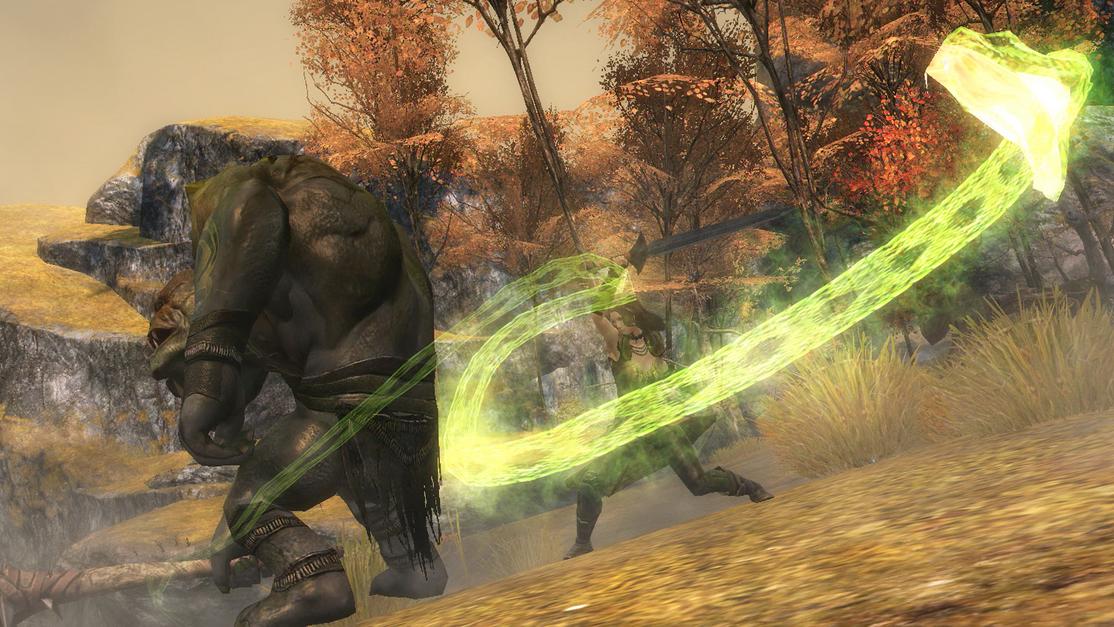
Ranger vs Ogre


Event system
Instead of a traditional quest system, there are dynamic events. As the world is explored, objectives become revealed by occurrences around the player. For example, a town under attack is identifiable by the destruction caused by enemies and townspeople fleeing. Defending the town gives rewards. There are over 1500 events that can occur in a dynamic system based on player action or inaction in the world. Participation in these events thus affects the state of the world.

Personal story

In the 250 years since the events of Guild Wars, the Elder Dragons have awoken. As massive forces of nature, these dragons have wreaked destruction across the continent of Tyria, forever changing its face and its inhabitants. The player is thrown into the midst of this destruction. Each character has its own biography which affects the story and how non-player characters react. As the game progresses, organizations can be joined and situations approached in different ways; these influences change the experience of the story as it advances towards the final confrontation with the Elder Dragon, Zhaitan. There are therefore thousands of different story permutations possible.

Non-combat interaction

Guild Wars 2 will have a "robust" crafting system. Mini-game activities are provided in major towns.

Video show-casing the dynamic events system.

Mechanics: Combat

Combat in Guild Wars 2 is built around three facets: damage, control and support. Damage is simply decreasing the enemy's health, control is preventing the enemy from doing what it wants, and support consists of boosting the abilities of allies. Each profession is able to perform any of these roles. While some professions may be better at an aspect than others, no character is a specialist in a particular role. For example, there is no profession which focuses on the healing aspect of support - the best healing abilities available in the game are the compulsory self healing skills.
Combat is designed to be tactical; items in the environment can be used as weapons, body position can affect skills, and skills which allies use can interact with the player to create new effects. Even what is done at the edge of death can change the outcome of the fight dramatically.


Mechanics: Customization

It is known that the character will be able to choose from five playable races and eight professions. Unlike in the first Guild Wars, there will be no secondary profession.
Visual customization of the character will include physical options such as body type, height, and advanced facial customizations including facial hair.

Biography

When creating a character a biography is created by answering several questions about the character. Each question will affect the personal storyline for the character. Race and profession determines most of the questions that are asked.

Custom story

The personal journey of each character is tailor-made according to history and character, but also based on his or her choices while playing. For example, a player may decide to save a certain NPC, while another may choose to let him die. The former may then choose to go on a mission to rescue his comrades from imprisonment, while the latter will not have that choice. A custom story aims to make a player feel that the game reacts according to his or her choices.